Lesson 1: What is shadow work?
Shadow work is the process of looking at the ‘shadow’ parts of yourself - those parts that you repress, hide and/or perceive as being undesirable - and making them conscious, so you can heal and move forward in your life.
It’s important to note that your shadows are not ‘dark’ or ‘evil’.
Whether you realise it or not, your journey through the first two modules of this course will have gifted you learnings and insights into your own shadows…
The ways you react that you’re not proud of
The ways you show up in your relationships that you wish were different
The aspects of yourself that you feel embarrassed by.
These are all your shadows.
Our shadows aren’t there to be shamed…
It’s about being curious and getting to know them, and showering them in acceptance, so you can move beyond them and live in a more aligned way.
While many of us tend to push away the parts of ourselves that we don’t like/feel proud of/wish were different…
The key to creating change actually lies in bringing them into the light…
Because when they are illuminated, they are no longer hidden, and you can bring compassionate healing to them.
Yes, it can sometimes feel easier to ignore and continue to repress your shadow parts - but this feeling is short lived.
In the long run, ignoring and repressing your shadows actually makes life feel harder…
Because regardless of your participation with them, they are still within you, simmering away and creating tension, anxiety, self-sabotage, depression and low self esteem (just to name a few!)
Knowledge about self is empowering and I want to take a moment to celebrate the fact that you’re here, in this course, being proactive in bringing your shadows into the light, so that you can move beyond them and truly blossom.
I hope you see the magnificence of what you’re doing.
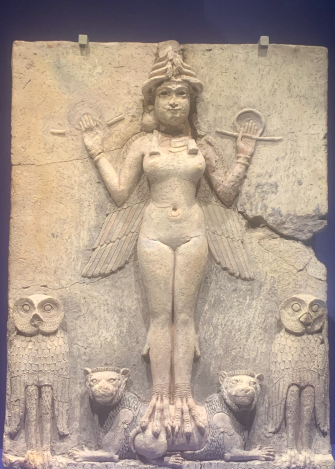
To help explore this topic more deeply (and in a fun way!) I want to share with you the ancient myth of Inanna, the Mesopotamian Goddess.
Inanna is one of the oldest female deities, and was the Sumerian Goddess of love, sensuality, fertility, procreation and war.
In the poem, The Descent of Inanna, Inanna journeys into the underworld to visit her sister Ereshkigal, the Queen of the Dead.
She leaves her Minister, Nincubura, with instructions to guard the mortal world in her absence, and seeks help from other priests and priestesses to ensure that she comes to no harm in the underworld.
Inanna goes into the underworld ‘armed’ with her seven divine powers. She is dressed in her finest clothes and wears the Crown of Heaven on her head and a golden breastplate. She carries her scepter, golden ring and the Rod of Power, as well as beads of precious lapis lazuli around her neck.
When her sister Ereshkigal is told that Inanna is at the gate, she is not happy. She tells her chief gatekeeper to bolt the seven gates of the underworld against Inanna, and to only let her pass through one gate at a time.
At each gate Inanna must remove one of her royal garments and relinquish one of her divine powers. When Inanna finally arrives in hell, she is naked, having been stripped of all her clothes and powers.
When the sisters finally meet, Ereshkigal pronounces Inanna guilty for refusing to honour a power greater than her own. Then, she hangs Inanna on a hook.
After three days and three nights, Inanna rises from the dead, as the Goddess of Heaven and Earth/Above and Below, and the cycle of life goes on.
What this ancient myth demonstrates is that each of us have a lightness and a darkness; a yin and a yang.
In this story, Ereshkigal, the Queen of the Dead, is but an aspect of Inanna, the Mesopotamian Goddess…
Just as your shadows are but an aspect of you.
Our shadows are inevitable and our descent into darkness (the stripping away of our ‘clothes’ and ‘powers’) are integral if we want to be free and ‘reborn’.
We ourselves must journey into the underworld and bring our 'dark' issues into the light, so that we can rise stronger.
We descend, not necessarily because we want to, but because we must, in order for us to grow and evolve.
For this lesson’s activity I would love for you to grab two pieces of paper and a pen.
On one piece of paper list your very own seven divine powers (or strengths).
On the second piece of paper (laid landscape) draw five columns…
Label the first column ‘Underworld’ and reflect on the times in your life when you have had to ‘descend’ into your own underworld. Was this a willing descension? Or was it unintentional, or even unwanted?
For example: I left my partnership of 10 years because I felt unheard, unseen and a lot of the time, unloved. It was a willing (but uncomfortable!) descension into the underworld.
Label the second column ‘Timing’. How old were you when you journeyed into these underworlds?
For example: 35 year old.
Label the third column ‘Issues’ and list what emotions arose in you, and what your primary concern was at this time.
For example: My relationship was all I had ever known for a very long time so choosing to exit the partnership felt very scary and uncomfortable.
Label the fourth column ‘Gifts’ and write what lessons and learnings the experience gifted you.
For example: It felt empowering and liberating! I felt like I was choosing myself.
Label the last column ‘Changes’ and share what you learned and what you would do differently next time. How might you choose to descend in the future if this issue/challenge were to arise again?
For example: I now choose different partners - ones who communicate clearly and respectfully, are committed to doing their own inner work and who value me and make me feel deeply loved and cared for.
Arjuna. X