Lesson 1: What is trauma?
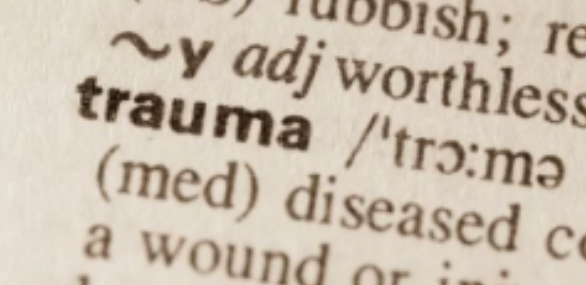
The meaning of the word "trauma", in its Greek origin is "wound".
Gabor Mate
Trauma occurs as a result of the experiences we have and the events that happen to us. Or put another way,"we become traumatised when our ability to respond to a perceived threat is in some way overwhelmed".1
Our body reacts and we can respond with a whole range of somatic (body-led) responses, the most common ones being; exhaustion, confusion, sadness, anxiety, agitation, numbness, dissociation, confusion and physical arousal i.e.flight, fright or freeze states (the last one is often forgotten), which are all very normal reactions to abnormal circumstances.2
Trauma can be a one off experience or event, multiple events, or long-lasting repetitive events. While most people are exposed to challenging events throughout their lifespan, it is how you respond, integrate and process stress and overwhelm which will speak to the severity of your trauma, as well as other external factors like how accessible support is for you.
Your traumas are entirely unique to you and what is traumatic and overwhelming for one person, will not be the same for another. Some examples of potential traumatic experiences include...
Witnessing an accident...
Your parent’s divorcing…
Being bullied at school…
Going to the dentist...
Experiencing financial distress…
Being raised by an adult who has a challenged relationship with food…
Losing a loved one...
These events can be complex in nature (usually chronic or over a long time) and can compound (defined by the exposure to multiple, often interrelated forms of traumatic experiences AND the difficulties that arise as a result of adapting to or surviving these experiences).3 All are potential traumas.
One of the most damaging aspects of trauma is that it takes us outside of ourselves, our body and nervous system becomes completely overwhelmed and instead of processing the trauma, we tend to repress it.
Processing of trauma = the release of trauma.
Repression of trauma = holding on to trauma.
Unfortunately, many of us are not taught how to process trauma and therefore carry many of our childhood wounds with us into adulthood.
When trauma is not processed it can:
Manifest in the body and result in physical, emotional and psychological illness, disease and inflammation (I highly recommend the books ‘The Body Keeps the Score’ by Bessel van der Kolk and ‘Becoming Supernatural’ by Dr. Joe Dispenza if you want to explore this topic!)
Numb and desensitise your central nervous system, effectively turning off parts of your perception and altering your reality
Result in you being on constant alert for ‘threats’ (e.g. a partner leaving, life throwing you a curveball or losing your life savings)
Become your point of reference in the world; your compass; your (false) True North
Impact the way you interact with and attach to people, and show up in your relationships
Skew your boundaries
Impact your self perception and how you care for and love yourself.
Living with unresolved trauma can feel overwhelming, pervasive and exhausting.
Our journey together in this course will focus mostly on the traumas you brought forward with you from your childhood, into your adulthood…
And the impact these traumas are now having on your life.
You will begin to unpack and understand:
What childhood experiences/events created trauma for you
How they are showing up in your adult life, and
How you can move towards resolving these traumas.
While enquiry will come, for now, the only ‘work’ I invite you to do is bathe yourself in love and kindness.
You have made the first and most courageous step...
You have chosen you!
Celebrate this!
There is nothing to ‘fix’, there is nothing ‘wrong’ with you, and you are absolutely not ‘broken’.
Know that your trauma is not you, nor does it define you. It is something that happened to you. It is an experience you wear.
I invite you to rediscover, unfurl and blossom, wherever you are on your healing path.
Arjuna. X
1. Peter Levine, 2008
2. Trauma-Informed Care in Behavioural Health Services, National Library of Medicine, 2014
3. complextrauma.org