Lesson 1: Descending Into Shadow
There are parts of ourselves we have learned not to look at.
The ways we react that we are not proud of. The feelings we suppress because they seem too dark, too inconvenient, or too frightening to acknowledge. The aspects of ourselves that we have tucked away — into silence, into busyness, into the performance of a self that is more acceptable to the world around us. Or they might simply be the drivers that sit behind our decisions and motivate us from the shadows.
These are our shadows values. Things that are kept hidden or concealed from sight.
Carl Jung, who first named and mapped the shadow as a psychological concept, understood it not as the dark side of the self but as the unlived life — everything that has been pushed underground because it was deemed unacceptable, dangerous, or simply too much. The shadow is not what is wrong with us. It is what has not yet brought into the light.
What Shadow Work Actually Is
Shadow work is the process of turning toward those hidden parts — with deep honest and compassion. To gently coax them gently into the light of conscious awareness where they can finally be met, understood and integrated.
Because here is what the shadow does when it is not acknowledged: it runs. It operates from beneath the surface of our conscious awareness, driving reactions we do not understand, attracting dynamics that mirror its unresolved content, creating the very situations we most want to avoid. The wound that is not seen does not disappear. It simply finds other ways to sustain itself often and maintain control.
Marion Woodman, whose life's work was devoted to the healing of the feminine psyche, wrote of the shadow as the place where our unlived potential waits — not just our pain, but our power. The parts of us that were too bright, too wild, too knowing to be safely expressed in the environments we grew up in. The anger that was not permitted. The desire that was shamed. The voice that was silenced. The body that was told it was too much.
These, too, are somatic shadows. And their reclamation is among the most important work this program will invite you into.
The Myth of Inanna — A Map for the Descent
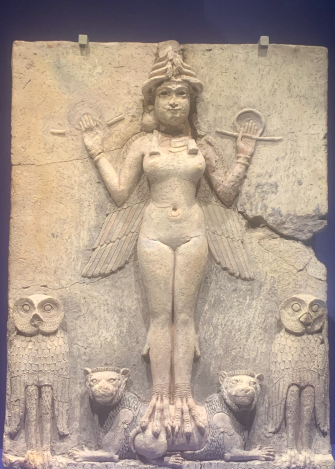
The oldest recorded narrative of shadow work is not found in a psychology textbook. It is found in the ancient Sumerian myth of Inanna — a story carved into clay tablets more than four thousand years ago, and as alive and relevant today as the moment it was first told.
Inanna is the Goddess of Heaven and Earth — radiant, powerful, clothed in her divine attributes. She decides, of her own choosing, to descend into the underworld to visit her sister Ereshkigal, the Queen of the Dead.
At each of the seven gates of the underworld, Inanna must surrender something. Her crown. Her lapis lazuli necklace. Her breastplate. Her ring. Her measuring rod. Her royal robe. Her dignity. At each gate she is stripped of another layer of who she believed herself to be — until she arrives before her sister naked, with nothing. Ereshkigal looks upon her and pronounces judgement. Inanna is hung on a hook and dies.
Three days and three nights pass.
And then — through the intervention of those she had the wisdom to prepare before she left — Inanna is restored to life. She rises from the underworld as something she was not before she descended. Not just the Goddess of Heaven. The Goddess of Heaven and Earth. Above and below. Light and dark. Whole.
What this myth understands — what it has always been understood — is that the descent is essential. It is the journey. The stripping away of what we thought we were in order to discover what we actually are beneath all of it. The willingness to face what lives in the underworld of the self — not to be destroyed by it, but to be transformed. It is an essential part of life - death - rebirth, and it is as old as time.
Every shadow work process follows the arc of Inanna's descent. We go down. We are laid bare, naked. We meet what lives there. And if we are willing to stay long enough — if we have the preparation, the support and capacity to hold love for every part of ourself — we rise. Different. More whole. More real.
Clarissa Pinkola Estés, in Women Who Run With the Wolves, describes this same descent through the lens of the wild woman archetype — the instinctive, knowing, ancient feminine self that survives precisely because she knows how to go into the darkness and come back. "The doors to the world of the wild Self are few but precious," she writes. "If you have a deep scar, that is a door. If you have an old, old story, that is a door."
Your shadows values are doors. This lesson is an invitation to begin opening them.
The Light in the Shadow
Before you move into the activity, it is important to name something that is often overlooked in shadow work: your shadow is not only the keeper of your wounds.
It is also the keeper of your unlived gifts.
The sensitivity that was shamed into hiding. The ambition that was told it was "not what we do in this family". The free spirit that was labeled and sexualised. The voice that learned to whisper when it wanted to roar. The creativity that was dismissed as impractical. The wildness that was civilised out of you so early you forgot it had ever existed.
These, too, live in the shadow. And their return — when you are ready, when the container is strong enough — is one of the most joyful and clarifying experiences this work can offer.
Activity: Your Seven Divine Powers and Your Underworld
For this lesson I invite you to take two pieces of paper.
On the first, write your seven divine powers — your own. The qualities, capacities and strengths that are most essentially you. Take your time. If this feels difficult, consider asking someone who loves you what they would name.
On the second piece of paper, drawn landscape, create five columns:
Underworld — the times in your life when you have had to descend. Willing or unwilling. The dark seasons. The threshold moments. The times you were stripped of something you thought was essential to who you were.
Timing — how old were you?
Issues — what arose in you during this time? What were you most afraid of? What did you most grieve?
Gifts — what did the descent eventually give you? What did you discover there that you could not have found any other way?
Changes — what did you learn? How would you move differently through a similar descent in the future, knowing what you know now?
Take your time with this. Let it breathe. You do not need to complete it in one sitting.
Arjuna x