Lesson 1: What is Trauma? Understanding the Wound
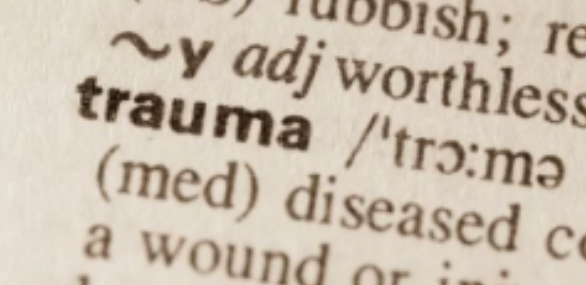
The meaning of the word "trauma", in its Greek origin is "wound".
Gabor Mate
To begin this journey, we first need to understand what we are working with.
The word trauma is used widely — and yet it is also widely misunderstood. Many people discount their own experiences because they don't believe what happened to them was bad enough to constitute trauma. They compare their story to someone else's and conclude that they have no right to be affected.
This is one of the most common — and most harmful — misconceptions about trauma. And it is the first thing we are going to gently dismantle together.
What Trauma Actually Is
In the words of physician and trauma expert Gabor Maté: "Trauma is not what happens to you. It is what happens inside you as a result of what happens to you."
This is one of the most liberating reframes available to us. It means that trauma is not defined by the magnitude of an event — it is defined by the impact that event has on your nervous system, your sense of self, and your capacity to be present in your own life.
A child who witnesses longterm parental conflict may carry as much unprocessed pain as a child who experienced overt abuse. A person who grew up with a parent who was emotionally unavailable — not cruel, not abusive, simply absent — may carry wounds as deep as those caused by more visible harm. A woman who was consistently told, subtly and persistently, that her feelings were too much, her needs inconvenient, her body something to be managed — carries trauma. Even if nobody ever raised their voice.
Trauma, as Bessel van der Kolk's decades of clinical research has demonstrated, is fundamentally about the loss of the capacity to be fully present. It is about a nervous system that learned, at some point, that the world was not safe — and has been responding from that place ever since.
Judith Herman, whose landmark work Trauma and Recovery remains one of the most important texts in the field, identified that trauma — particularly complex, relational trauma — follows recognisable patterns of impact: the disruption of safety, the fracturing of memory, the loss of connection to self and others. Her three-stage recovery model — establishing safety, remembrance and mourning, and reconnection with ordinary life — maps almost precisely onto the arc of this program. You will not see those stages named explicitly in every lesson, but they are the bones beneath everything we will do together.
Recognising Trauma in Yourself
Because trauma is so often minimised — by ourselves and by others — it can be helpful to have a framework for recognising its presence. The following questions, drawn from van der Kolk's clinical work, are not a diagnostic tool. They are an invitation to recognition.
Sit with each one. Notice what arises in your body as you read.
Do you find yourself reacting to situations with an intensity that surprises even you?
Do you feel chronically on guard — waiting, even in moments of safety, for something to go wrong?
Do you have difficulty feeling truly safe — in your body, in your relationships, in stillness?
Are there periods of your childhood or past that feel hazy, frozen or difficult to access?
Do you experience physical symptoms — chronic pain, fatigue, digestive issues, hormonal dysregulation, autoimmune conditions — for which there is no clear medical explanation?
Do you feel disconnected from yourself, your emotions or your body — as though you are watching your life from a slight distance?
Do you find yourself drawn, repeatedly, to dynamics or relationships that echo patterns from your past?
Do you find it difficult to receive love, care or support — or to ask for it?
If any of these feel familiar, you are in exactly the right place.
What Can Be Traumatic
Trauma can arise from a single overwhelming event — an accident, an assault, a sudden loss. But it can also arise from the accumulated weight of experiences that were not, in isolation, catastrophic — but that, over time, shaped the way you see yourself and the world.
These experiences might include:
Growing up in an environment where emotions were not welcome or were punished
Having a parent or caregiver who was physically present but emotionally unavailable
Experiencing ongoing criticism, shaming or belittling
Witnessing conflict, addiction or mental illness in your family of origin
Being parentified — asked or expected, as a child, to carry the emotional weight of the adults around you
Experiencing bullying, social exclusion or humiliation
Medical trauma — painful procedures, frightening diagnoses, feeling dismissed or unheard by healthcare providers
The gradual erosion of your sense of self through a relationship that asked you to be smaller than you were
Losing someone before you had the capacity to grieve them properly
Living through periods of ongoing uncertainty, instability or financial precarity
Experiencing discrimination, racism, homophobia, sexism or other forms of systemic harm — wounds that are not only personal but collective, carried in the body across generations
This list is not exhaustive. Your experience does not need to appear on it to be valid. If something has left a lasting imprint on how you feel about yourself and the world — it matters. You matter.
Little "t" and Big "T" Trauma
You may have encountered the terms "little t" trauma and "big T" Trauma — a distinction that can be genuinely helpful in expanding our understanding of what counts.
Big T Trauma refers to events that are widely recognised as overwhelming — war, assault, serious accidents, natural disasters, the sudden death of someone we love. These are experiences that most people would acknowledge as traumatic without hesitation.
Little t trauma refers to experiences that may seem less dramatic on the surface but that have a lasting, significant impact on the nervous system and the sense of self — chronic emotional neglect, persistent criticism, childhood bullying, the slow erosion of self-worth in a diminishing relationship, the accumulated weight of never feeling seen or safe. These experiences are often minimised — by ourselves most of all — precisely because they don't look like what we have been told trauma is supposed to look like.
What Gabor Maté's research in The Myth of Normal makes clear — and what his clinical work across decades consistently demonstrates — is that trauma, in all its forms, is far more common than most of us realise. Approximately 80% of people have experienced some form of traumatic event or chronic traumatic stress in their lifetime. This is not a statistic about other people. It is a statistic about us — about our families, our communities, our colleagues, the people we love.
Neither little t nor big T trauma is more valid than the other. Both leave imprints. Both deserve attention, compassion and care. The question is never whether what happened to you was bad enough to matter. The question is simply: how is it still living in you?
What Happens Inside When Trauma Occurs
When we experience something overwhelming — something our nervous system cannot fully process in the moment — the body does something remarkable. It stores it.
This is not a malfunction. It is an act of profound intelligence. The body holds what the mind cannot yet bear to know — protecting us, in the short term, from being overwhelmed.
But what is stored does not disappear. It waits.
Trauma researcher Peter Levine describes unresolved trauma as a kind of frozen survival response — an incomplete cycle of activation in the nervous system that never got to finish. Like an animal that freezes in the face of a predator and then, once the danger has passed, shakes and trembles to discharge the activation — we humans, uniquely, often interrupt this process. We override the shake, suppress the tears, push through the trembling. And so the activation remains, held in the body, looking for resolution.
Stephen Porges' Polyvagal Theory offers us another layer of understanding. His research reveals that our nervous system operates across three distinct states. The first is ventral vagal safety — the state in which we feel connected, curious, open and at ease. The second is sympathetic activation — the fight, flight or freeze response, in which we are mobilised for danger. The third is dorsal vagal shutdown — a state of collapse, disconnection and freeze that the nervous system moves into when the threat feels inescapable.
Many people who have experienced trauma live predominantly in the second or third of these states — even when the original danger has long since passed. Understanding this is not a diagnosis. It is a map. And maps, in unfamiliar territory, are everything.
We will return to Porges' work in depth in Module 3. For now, simply notice: which of these states feels most familiar to you?
The Nervous System's Response to Threat
When the nervous system perceives danger — whether that danger is a physical threat, an emotional wound, or a memory of one — it responds in one of three primary ways.
Fight — mobilising toward the threat with energy, anger and action.
Flight — mobilising away from the threat with urgency and speed.
Freeze — collapsing inward, becoming still, dissociating from the experience.
These responses are not choices. They are ancient, automatic, extraordinarily intelligent survival mechanisms. They kept our ancestors alive. They kept you alive, at the times in your life when you needed them most.
The difficulty arises when the nervous system cannot distinguish between the original threat and the present moment — when a look, a tone of voice, a smell, a dynamic in a relationship activates the same survival response as the original wound. This is the nature of trauma: the past becomes present, unbidden, in the body.
Understanding this — truly understanding it — is one of the most compassionate things you can offer yourself. Your reactions are not character flaws. They are the faithful echoes of a nervous system that learned, long ago, how to keep you safe.
A Note on Authentic Hope
As we begin this journey together, I want to offer you something that is neither false optimism nor clinical detachment.
I want to offer you truth.
The truth is that healing is possible — not as an arrival, but as a growing capacity. The truth is that the nervous system is plastic — it can learn new patterns, build new pathways, and develop new ways of responding. The truth is that the body, however much it has held, is also profoundly oriented toward wholeness.
And the truth is that this will take time. It will ask things of you. There will be moments in this program when the work feels hard, when old pain surfaces, when you wonder if anything is shifting.
In those moments, return to this: the goal is not to be free of what happened. The goal is to build the capacity to be present with yourself — in your full, complex, beautifully human reality — without being overwhelmed by it.
That capacity is already within you. This program will help you find it.
Journal Prompts for Lesson 1
Take your journal and spend time with whichever of these questions call to you. There is no obligation to answer all of them — let your intuition guide you to what feels most alive.
Which of the experiences listed above resonated with you? What would you add to the list from your own life?
Which of the recognition questions felt most familiar? What did you notice in your body as you read them?
Which nervous system state feels most familiar to you — ventral vagal safety, sympathetic activation, or dorsal vagal shutdown?
How has what you have experienced in your past shaped how you show up in your life today? What patterns do you notice?
What does the idea of healing as capacity building — rather than arrival — feel like to you? Is there relief in it? Resistance? Both?
Before You Continue
Place one hand on your heart and one hand on your belly. Take three slow, deep breaths — making your exhale longer than your inhale. Feel the weight of your hands. Feel the rise and fall of your breath.
You have just done something courageous. You have turned toward yourself.
That is where all healing begins. I invite you to unfurl and blossom.
Arjuna x